

DPT – Dye Penetrant Testing
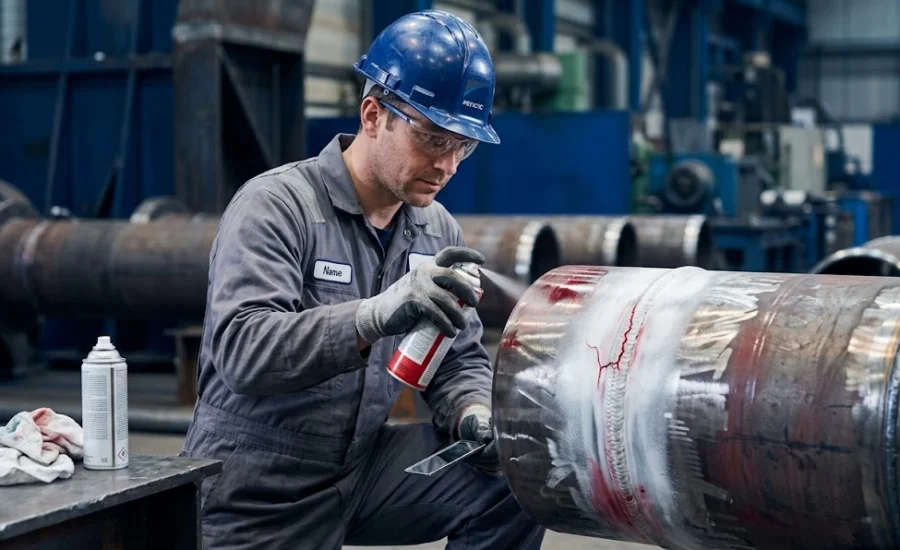
About DPT
Dye Penetrant Testing (DPT) is a widely used surface inspection method for identifying defects that are open to the surface of a component.
The process uses a liquid penetrant that is applied to the inspection surface. The penetrant enters surface-breaking cracks and other discontinuities. After removing the excess penetrant, a developer is applied to draw the penetrant back out of the defects, making the indications visible for evaluation.
DPT can be used on non-porous materials, making it suitable for applications where magnetic particle testing cannot be used.
How DPT Works
01 — Apply Penetrant
02 — Allow Penetration
03 — Remove Excess
04 — Apply Developer
Applications
- Non-Ferrous Materials : Suitable for surface inspection of non-ferrous materials.
- Weld Surface Inspection : Used to identify surface-breaking defects in weld areas.
- Casting Defects : Applied to detect relevant surface defects in cast components.
Key Advantages
Why Choose Dye Penetrant Testing?
Simple Method
DPT is a straightforward surface inspection technique.
Cost Effective
Provides a relatively low-cost method for surface defect detection.
Suitable for Non-Porous Materials
Can be used on suitable non-porous materials, including non-ferrous components.
Limitations
Understanding DPT Requirements
Surface Defects Only
DPT detects defects that break through to the surface and cannot identify internal defects.
Surface Cleaning Required
Proper surface cleaning is required before testing to obtain effective results.
DPT at LOHITHA Services
Professional Surface Inspection
Dye Penetrant Testing forms part of LOHITHA Services’ NDT capabilities for surface defect inspection. The method provides a practical solution for identifying relevant surface-breaking discontinuities in suitable components.
Our inspection services are delivered with a focus on quality, safety, accuracy and timely execution.
Recent Services
- Inspection & Consultancy
- Thickness Gauging
- Boroscopy Inspection
- Hardness Testing
- Positive Material Identification
- RT – Radiography Testing
- PWHT – Post Weld Heat Treatment
- Post Heating
- Preheating
- Vacuum Box Testing
- MPT – Magnetic Particle Testing
- UT – Ultrasonic Testing
- PAUT – Phased Array Ultrasonic Testing